How-To
Teaching English Learners in Any Subject: A Free Short Course
A free short course for subject teachers with English learners: why lessons lose them, and what to change in your talk, key words, texts and checks.
By Logan Shaffer · · 21 min read
This free course is for teachers with students still learning English in a science, history, maths or any other subject class, and for the EAL and ELD teachers who support them. Schools call these students English learners, ELLs, EAL students or multilingual learners. The whole course is on this page: five short lessons, each ending with one change to try in your next class.

Who It's For
- Subject teachers in international and public schools, from primary to the end of secondary, whether they teach one English learner or a whole class of them.
- EAL, ESL and ELD specialists looking for something practical to share with colleagues.
- Coordinators who lead English-learner support and need short staff training that teachers will actually use.
The Course on One Page
All five lessons fit on one printable page. Download the one-page summary as a PDF to pin up in a staffroom or hand to a colleague.
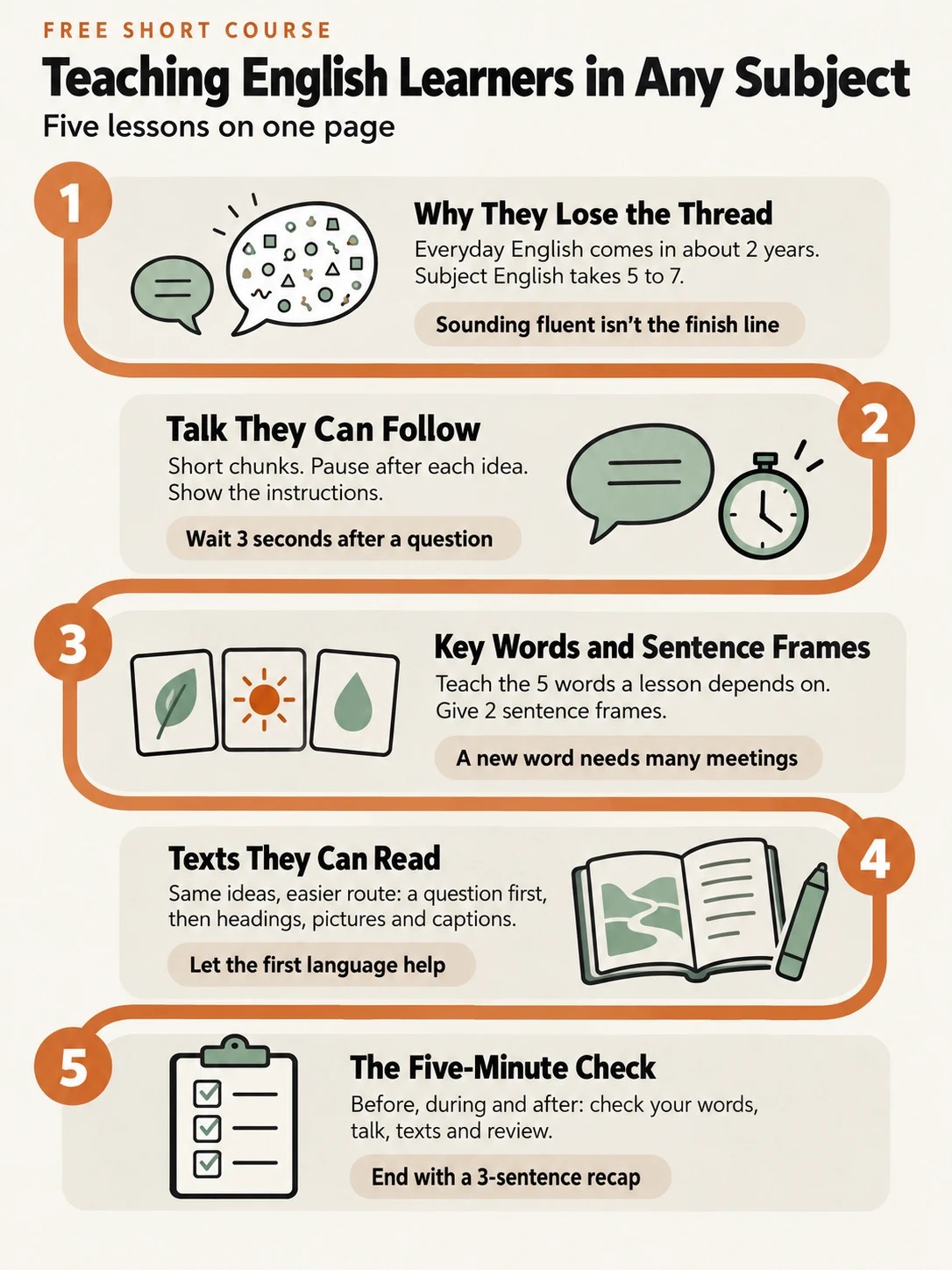
The Five Lessons
- Why English Learners Lose the Thread in Subject Classes: two kinds of English, how long each takes, and the three places a lesson loses a student.
- Teacher Talk English Learners Can Follow: shorter chunks, longer pauses, instructions students can see, and checks that need an answer.
- Key Words and Sentence Frames for English Learners: choosing the words a lesson depends on, explaining them so they stick, and giving students sentences to use them in.
- Making Subject Texts Readable for English Learners: opening up a textbook page without watering down the content, and letting the first language help.
- A Five-Minute Check for Lessons with English Learners: checking your own lesson before, during and after, reading proficiency levels, and working with your EAL specialist.
Each lesson explains the research in plain words, shows what the idea looks like in a subject class, with examples from science, history and maths, and closes with one thing to try tomorrow. Most sources are linked where a lesson uses them, and every source is listed under References at the end.
For EAL Coordinators
If you lead English-learner support, you can use this course as short staff training. Send it to subject teachers before a department meeting, or read one lesson together and let each teacher pick one change to try for two weeks. The lessons ask for no new software and no change to the curriculum.
Lesson 1Why English Learners Lose the Thread in Subject Classes
Picture a Grade 9 student who chats easily with friends at lunch, then goes quiet in biology. It's tempting to read that silence as a problem of effort or confidence. More often the problem is the language itself, because the English of a biology lesson is a different English from the one at the lunch table.
This lesson names that difference, shows how long it takes to close, and marks the three places a subject lesson most often loses a student. The rest of the course works on those three places.

Two Kinds of English
The researcher Jim Cummins named the difference in a 1979 paper (opens in a new tab). He called the English of everyday conversation BICS, short for basic interpersonal communicative skills. He called the English a student needs to understand and explain the ideas of a school subject CALP, short for cognitive academic language proficiency.
Cummins later described the gap with two scales that cross. The first measures how much the situation helps. A lunch-table conversation comes with faces, gestures, tone of voice and things both people can see, so a student can work out a lot from what surrounds the words. At the far end of that scale, meaning rests on the words alone, as in a textbook sentence such as "The treaty was signed; consequently, trade restrictions were lifted."
The second scale measures how much a task asks a student to hold in mind at once. Chatting about the weekend asks very little, while explaining why a treaty changed trade asks a lot.
The lesson that loses a student usually sits at the hard end of both scales at once.
How Long Each Takes
Cummins traced the distinction to a second look at language data the Toronto Board of Education had collected from immigrant students. Those students reached the conversational English of their classmates in about two years. Coming close to grade norms in academic English took five to seven years on average. Cummins adds that teachers and psychologists often read fluent conversation as a sign that a student had no difficulty left with English.
Kenji Hakuta, Yuko Goto Butler and Daria Witt measured the same gap in a 2000 report (opens in a new tab), using data from two San Francisco Bay Area districts. Spoken English took three to five years to develop there, and academic English could take four to seven. Their samples counted only students who had stayed in the same district since kindergarten, so the authors warn that the real figures may run longer.
Some researchers have criticised the distinction, and Cummins answers their objections (opens in a new tab) in a 2000 book chapter. For a subject teacher, the practical point holds.
A student who sounds fluent can still lose the lesson the moment the language turns abstract, and closing that gap takes years.
Where a Subject Lesson Loses a Student
In my experience, three moments do most of the damage.
- Listening in real time. A listener hears each sentence once, at the speaker's speed. Long explanations with nothing written down lose students fastest. Lesson 2 works on your talk.
- The words the lesson depends on. Subject terms such as photosynthesis get taught. The general academic words around them, such as analyse, therefore and despite, usually don't, and they can block a student just as hard. Lesson 3 works on words and sentences.
- The text and the task. A dense textbook page or a long written question can test reading more than it tests the subject. Lesson 4 works on texts.
Behind all three sits a double load. A student is learning new content through a language they are still learning, so every unclear sentence costs them twice.
What a Student Already Brings
A student's first language is part of the picture. Cummins argues that academic skills a student builds in one language support the same skills in another, an idea he calls linguistic interdependence. A student who studied photosynthesis at school in Korean already has the idea and needs the English words for it. A student who never met the idea needs both. Asking what students already know, in any language, tells you which of those two jobs you are doing.
In Your Subject
- Science leans on precise verbs and passive sentences, such as "The solution is heated until the water evaporates." Lab instructions often pack several steps into one sentence.
- History runs on the language of time and cause: led to, as a result, whereas, by the late 1800s. One long sentence can carry three dates and four names.
- Maths hides the operation in small words. Less than, per, product and of decide what a word problem asks, so a student who reads every other word correctly can still solve the wrong problem.
Try This Tomorrow
Take tomorrow's lesson plan and mark three things:
- Every stretch where students must listen with nothing written down.
- The five words the lesson can't work without.
- The longest text students must read on their own.
Keep the marked plan, because lessons 2, 3 and 4 each start from one of those marks.
Lesson 2Teacher Talk English Learners Can Follow
A reader can go back over a hard sentence. A listener hears it once.
Picture a Grade 7 geography lesson on the water cycle: you explain evaporation, add a note about clouds, move on to condensation and finish with rain, all in one long stretch of talk. A student who joined the class this year follows your first sentence. When you reach condensation, she stops to work out what the word means, and by the time she has it, you are three sentences further on.
She can't play that minute again, so she copies whatever the student beside her writes.
Your talk is the part of the lesson you control most directly. Five habits give English learners a better chance of catching it.

Five Habits That Help
Shorter chunks. A chunk is the stretch of speech between two pauses. A long chunk makes a listener hold the start of an idea while still decoding the end. Stop after each idea, even for a breath, so a student who is translating in their head can catch up before the next idea arrives.
A longer wait after questions. Wait time is the silence between your question and the moment someone speaks. A student answering in a second language has to understand the question, think of an answer and then find the English words for it. If the same quick students answer every time, that student rarely reaches the last step.
Key sentences repeated in the same words. It's tempting to say a main point once and then rephrase it three ways to help. A first-language speaker hears variety, while a student still learning English hears four different sentences to decode. Say the key sentence again in the same words, so a student who missed a word the first time knows which gap to listen for. Rephrase afterwards, once the core sentence has come round twice.
Instructions students can see. Spoken instructions vanish at the moment students need them most, when they start the task. Keep instructions short, write the steps on the board in order, and show one example before students begin. Then ask one student to tell the class the first step. That checks the instruction without putting anyone on the spot about their English.
Checks that need an answer. "Do you understand?" almost always gets a yes, because saying no in front of the class costs too much. Ask a question that only someone who understood can answer, such as "Which comes first, evaporation or condensation?" or "Point to the part of the diagram where the water cools." Let students answer on mini whiteboards or with a partner first, so a wrong answer stays private.
What the Research Says
Mary Budd Rowe, a professor of science education at the University of Florida, noticed in tape recordings of science lessons how quickly teachers moved on after asking a question. She spent years testing longer waits in elementary science classes, and her 1986 review (opens in a new tab) reports what changed.
With the usual short waits, six or seven students typically took more than half of the answering time. When teachers waited about three seconds or longer, students gave much longer answers, fewer said "I don't know" or nothing at all, and a wider range of students joined in, including students their teachers usually rated as weak.
Rowe's studies did not focus on students learning English, so applying her results to them is my inference. I think it's a fair one, because a student answering in a second language has more steps to get through before they can speak.
Craig Chaudron's 1988 review of research on second-language classrooms (opens in a new tab) reports that teachers of language learners adjust the way they talk: they seem to speak more slowly, probably pause more often and for longer, and may repeat themselves more. Roger Griffiths tested speed directly in a 1992 study (opens in a new tab) with Japanese learners of English at a lower-intermediate level, who understood passages better at the slowest of three speeds.
A listening test can't tell you how slowly to explain something to a mixed class, so judge your pace by watching faces and by the answers to your checks.
In Your Subject
- Science: before a practical, write the steps on the board as a numbered list and point to each one as you say it. Ask "What do you do after you heat the tube?" before anyone picks up equipment.
- History: when you tell a story of cause and effect, pause after each cause and add it as a short line on a timeline.
- Maths: talk through a worked example one step at a time, write each step as you say it, and ask a pair to explain step two back to you before you move on.
Try This Tomorrow
- Pick one question you plan to ask. Count silently to five before you call on anyone, and keep your eyes on the class while you count.
- Write tomorrow's task instructions as numbered steps on the board, and ask one student to tell the class step one.
- Replace one "Do you understand?" with a question that needs the idea to answer.
Afterwards, note who answered during the long wait. If it was someone who usually stays quiet, the habit is working.
Lesson 3Key Words and Sentence Frames for English Learners
Every subject lesson rests on a handful of words. Ask yourself this while you plan: if a student understood every idea in the lesson but only half the words, which words would block them? Those are the words to teach on purpose. This lesson covers how to choose them, how to explain them, how often students need to meet them, and how to give students sentences to use them in.

Choose Five Words
Isabel Beck, Margaret McKeown and Linda Kucan sort words into three tiers (opens in a new tab) so a teacher can decide where the teaching time goes. The example words here are mine.
- Tier One words carry everyday talk: table, happy, walk. Most rarely need teaching, though a newcomer to English may need a few.
- Tier Two words run through the writing of every subject and come up rarely in casual talk: analyse, compare, significant, hence. Beck and her colleagues put the teaching time here, because students meet these words across subjects and seldom pick them up on their own.
- Tier Three words belong to one subject: photosynthesis, tariff, isosceles.
Subject teachers usually pre-teach Tier Three and skip Tier Two. A science teacher teaches photosynthesis, then the worksheet asks students to analyse the results, and nobody stops on analyse because it doesn't sound like a science word.
Choose five words before each lesson, and make at least one of them a Tier Two word.
Five is my working number, and no study picks it, so adjust it to your class. A short list forces you to decide which words carry the lesson, and it leaves time to use each one more than once.
Explain Each Word in Plain English
Write a one-line explanation of each word, using only words your students already know. Dictionary definitions often fail that test, because they explain a hard word with more hard words.
- Dictionary style: analyse, to examine the component elements of something in a systematic manner.
- Plain English: analyse, to look closely at the parts of something to find out how it works or why it happened.
Say the plain version aloud the first time you use the word, then write it beside the word on the board.
When students share a home language, a translation often lands faster. Check it with a colleague or a confident bilingual student first, because a translation tool can give you a word's everyday sense when your lesson needs its subject sense. In chemistry, solution means a mixture with one substance dissolved in another, and a tool may give you the word for the answer to a problem.
Plan More Than One Meeting
The vocabulary researcher Paul Nation points out in his book (opens in a new tab) that knowing a word means knowing its form, its meaning and how it's used, and that any language holds far more words than a teacher can teach one by one. One explanation buys a student one meeting with a word, and one meeting rarely finishes the job.
Stuart Webb measured what repeated meetings buy in a 2007 study (opens in a new tab). He worked with 121 Japanese university students learning English, who met unfamiliar words in short reading contexts once, three, seven or ten times. Each time the number of meetings rose, students scored higher on at least one part of knowing a word.
Even after ten meetings, students wrote the meaning of fewer than three of the ten words from memory on average, and Webb concludes that full knowledge of a word may take more than ten meetings.
Webb tested reading, and most meetings with a word in a subject class arrive through talk, so carrying his numbers across is my inference. The practical point holds anyway. Use each of your five words on purpose several times in the lesson, write it on the board as you say it, and bring it back later in the week.
Give Students Frames to Use the Words
A sentence frame is a sentence with blanks to fill, such as "A plant needs ___ to make ___." The student supplies the content and the frame supplies the grammar.
A student explaining a cause in a second language has two jobs at once: working out the idea, and building an English sentence to hold it. A frame takes over much of the second job, so the student can spend their effort on the first, which is the part a subject teacher needs to see.
Write two frames for each lesson, one to name or describe and one to explain a cause or make a comparison.
- Science: "If there is less ___, the plant ___ because ___."
- History: "The ___ was signed; consequently, ___."
- Maths: "I know the answer is reasonable because ___."
Say each frame aloud, write it on the board, and model one full answer before pairs start talking. Offer a harder second frame for students who are ready, and let students who don't need frames ignore them. Take frames away over a unit, so students still practise building sentences of their own.
For further reading, Pauline Gibbons's Scaffolding Language, Scaffolding Learning covers classroom talk and the move from speaking to writing (opens in a new tab). Jeff Zwiers's Building Academic Language traces how academic language changes from one subject to the next.
Try This Tomorrow
- Write down the five words tomorrow's lesson depends on, including at least one Tier Two word.
- Write a plain-English line for each one, using only words your students know.
- Write two frames, one to describe and one to explain.
- Put the words on the board before students arrive, use each one on purpose in the first ten minutes, and hand out the frames when students turn to a partner.
After the lesson, note one word you didn't list that tripped someone up. It goes on next week's list.
Lesson 4Making Subject Texts Readable for English Learners
A textbook page can test reading more than it tests the subject. A student who could explain the causes of a war in their first language may stall on a page of long sentences, unfamiliar names and three new terms in one paragraph. Simplifying the ideas would teach that student less.
Keep the ideas, and change the route to them.

Before Reading: Give Students a Way In
Students read better when they know roughly what's coming. Before a text, give them three things: the key words from lesson 3, a picture or diagram of the main idea, and one question the text answers. "Read pages 42 and 43" becomes "Read to find out why the river floods every spring." A student who knows what to look for can skip past what they don't need yet.
Break the Page Up
You can often keep the original text and change how it's laid out.
- Add a short heading above each section that says what it's about.
- Split long paragraphs so each one carries one idea.
- Turn a process into numbered steps, and a sequence of events into a timeline.
- Put the five key words in bold, with the plain-English line from lesson 3 in the margin.
When you write your own text, use shorter sentences and say who did what. "Farmers cleared the forest" reads more easily than "The forest was cleared." Keep the subject terms, because students will meet them in tests and later lessons.
Show It as Well as Say It
A diagram, a labelled picture or a graphic organiser carries meaning that doesn't depend on English. A table comparing two empires, a flowchart of a reaction or a number line beside a word problem gives a student something to check their reading against.
Let students show what they understand the same way. Labelling a diagram, sorting cards or completing a table can show you what a student knows about the subject while their written English catches up.
Seeing and Hearing Together
When you show a video, turn on captions in the language of the video. In 2013, Maribel Montero Perez, Wim Van Den Noortgate and Piet Desmet pooled 18 studies of captioned video (opens in a new tab). Learners who watched with captions did better on listening comprehension and vocabulary than learners who watched the same video without them, and the authors call both effects large.
A 2025 review (opens in a new tab) by Satsuki Kurokawa, Aung Myo Hein and Takumi Uchihara still found a medium benefit for picking up new words, and almost none for lecture-style videos made for native speakers.
Most learners in these studies were older than school students, many of them at university, and they watched recorded video. So the research says little directly about a live lesson. Two habits follow from it anyway: teach the key words before you press play, and write key ideas on the board as you say them, so students hear and see the same words at once.
Let the First Language Help
A student's first language can carry them into an English text. In a 2014 book (opens in a new tab), Ofelia García and Li Wei use the word translanguaging for students drawing on every language they know to make sense of things. In a subject class, that can look like this:
- Students who share a language discuss the text in it before they answer in English.
- A short glossary gives the key words with translations, checked by someone who knows both languages.
- A student reads a summary in their first language first, then the English text.
Keep the answer in English when English is what you're assessing, and let the first language carry the meaning on the way there.
Try This Tomorrow
Take the longest text you marked in lesson 1.
- Write one question the text answers, and put it at the top.
- Add headings, and bold the five key words.
- Add one picture, diagram or table that shows the main idea.
- If students share a home language, let partners discuss the question in it before they write their answer in English.
Afterwards, ask one English learner which change helped most.
Lesson 5A Five-Minute Check for Lessons with English Learners
The first four lessons each changed one part of a lesson. This one puts them together into a check you can run in five minutes while you plan. It also adds the two things that keep the changes going: knowing your students' English levels, and working with the EAL specialist in your school.

The Check
Before the Lesson
- I know which students are still learning English, and roughly their level.
- I've chosen the five words the lesson depends on, each with a plain-English line.
- I've written two sentence frames, one to describe and one to explain.
- The main text has a question at the top, headings, and a picture or diagram.
During the Lesson
- I explain in short chunks and pause after each idea.
- I wait at least three seconds after a question, and let partners talk first.
- Instructions are numbered steps on the board, and a student tells the class step one.
- I check understanding with a question that needs the idea to answer.
- Students who share a language can use it to work out meaning.
After the Lesson
- We wrote a three-sentence recap of the lesson together.
- The next lesson opens with two minutes of recalling the five words.
Why the Recap and the Recall Work
Speech disappears as soon as you say it.
A written recap gives a student a second pass at the lesson, at home and at their own reading speed. Writing it with the class, in three sentences, also makes students pull the lesson back out of memory.
Researchers call that pulling back retrieval practice. In a 2006 study (opens in a new tab), Henry Roediger and Jeffrey Karpicke had university students read short passages, then either reread them or close them and write down what they remembered. On a test two days later, students recalled 68 percent of the ideas in a passage they had written out from memory, against 54 percent in a passage they had only reread.
A 2006 review (opens in a new tab) by Nicholas Cepeda and his colleagues pooled hundreds of experiments on spacing, which means studying the same material in separate sessions, and found that spaced study beat study packed into one session in almost every comparison. The authors recommend separating study sessions by at least a day.
Both papers come from memory research with mostly adult participants. Applying them to a class of 13-year-olds still learning English is a guess, though a cheap one to test, because both routines take a few minutes.
If your school uses MAMAKO, it drafts the recap for you after class, with the lesson's key words, and you check it before students open it by link.
Know Your Students' Levels
Most schools describe English learners on a proficiency scale. Many international schools use the CEFR, the Common European Framework of Reference for Languages (opens in a new tab), which runs from A1 for beginners to C2 for very advanced users. Many US schools and some international schools use the WIDA scale (opens in a new tab), which runs from level 1, Entering, to level 6, Reaching.
Ask your EAL team which scale your school uses and where each of your students sits on it. Then ask what that level means for reading and writing in your subject. A student at an early level needs the words, frames and visuals from this course in almost every lesson. A student at a later level may need them only for new topics and longer texts.
Work with Your EAL Specialist
If your school has an EAL, ESL or ELD teacher, they are your best source of help, and they rarely have time to visit every class. Make the most of a short conversation:
- Share the key words and the main text of your next unit a week ahead, so they can preview them with students.
- Ask which two students need the most support in your subject, and what each one can already do in English.
- Agree on one change from this course you will try, and tell them how it went.
Try This Tomorrow
Run the check above on tomorrow's lesson. Note what's already there, and pick two items to add. After the lesson, write down which of the two made the bigger difference, and send that note to your EAL specialist.
Where to Go from Here
That's the whole course. Keep the one-page summary beside you while you plan, try one change at a time, and come back to a lesson when a class needs it.
References
- Cummins, J. (1979). Cognitive/academic language proficiency, linguistic interdependence, the optimum age question and some other matters. Working Papers on Bilingualism, No. 19, 121-129. https://eric.ed.gov/?id=ED184334 (opens in a new tab)
- Cummins, J. (2000). Putting language proficiency in its place: Responding to critiques of the conversational/academic language distinction. English in Europe: The acquisition of a third language, In J. Cenoz and U. Jessner (Eds.), chapter 4, pp. 54-83. Multilingual Matters. https://doi.org/10.21832/9781800417991-005 (opens in a new tab)
- Hakuta, K., Butler, Y. G., and Witt, D. (2000). How long does it take English learners to attain proficiency?. University of California Linguistic Minority Research Institute, Policy Report 2000-1, January 2000. https://eric.ed.gov/?id=ED443275 (opens in a new tab)
- Rowe, M. B. (1986). Wait time: Slowing down may be a way of speeding up!. Journal of Teacher Education, 37(1), 43-50. https://doi.org/10.1177/002248718603700110 (opens in a new tab)
- Chaudron, C. (1988). Second language classrooms: Research on teaching and learning. Cambridge University Press, Cambridge Applied Linguistics series. Chapter 3, Teacher talk in second language classrooms, pp. 50-89. https://doi.org/10.1017/CBO9781139524469 (opens in a new tab)
- Griffiths, R. (1992). Speech rate and listening comprehension: Further evidence of the relationship. TESOL Quarterly, 26(2), 385-390. https://doi.org/10.2307/3587015 (opens in a new tab)
- Beck, I. L., McKeown, M. G., and Kucan, L. (2013). Bringing Words to Life: Robust Vocabulary Instruction. Guilford Press, 2nd ed., 210 pp. Chapter 2, Choosing Words to Teach: the three tiers at p. 20, and the case for putting Tier Two first at pp. 30-31. ISBN 978-1-4625-0816-7. https://www.guilford.com/books/Bringing-Words-to-Life/Beck-McKeown-Kucan/9781462508167 (opens in a new tab)
- Nation, I. S. P. (2013). Learning Vocabulary in Another Language. Cambridge University Press, 2nd ed., Cambridge Applied Linguistics. Chapter 2, Knowing a word, pp. 44-91, and chapter 3, Teaching and explaining vocabulary, pp. 92-160. https://doi.org/10.1017/CBO9781139858656 (opens in a new tab)
- Webb, S. (2007). The effects of repetition on vocabulary knowledge. Applied Linguistics, 28(1), 46-65. https://doi.org/10.1093/applin/aml048 (opens in a new tab)
- Gibbons, P. (2015). Scaffolding Language, Scaffolding Learning: Teaching English Language Learners in the Mainstream Classroom. Heinemann, 2nd ed., Portsmouth, NH, 272 pp. Chapter 2, Classroom Talk: Creating Contexts for Language Learning, and chapter 4, From Speaking to Writing in the Content Classroom. ISBN 978-0-325-05664-7. https://www.heinemann.com/products/scaffolding-language-scaffolding-learning-second-edition-e05664.aspx (opens in a new tab)
- Zwiers, J. (2014). Building Academic Language: Meeting Common Core Standards Across Disciplines, Grades 5-12. Jossey-Bass, 2nd ed., San Francisco, 342 pp. Chapter 4, Content Area Variations of Academic Language. ISBN 978-1-118-74485-7.
- Montero Perez, M., Van Den Noortgate, W., and Desmet, P. (2013). Captioned video for L2 listening and vocabulary learning: A meta-analysis. System, 41(3), 720-739. https://doi.org/10.1016/j.system.2013.07.013 (opens in a new tab)
- Kurokawa, S., Hein, A. M., and Uchihara, T. (2025). Incidental vocabulary acquisition through captioned viewing: A meta-analysis. Language Learning, 75(4), 939-987. Published online 10 December 2024. https://doi.org/10.1111/lang.12697 (opens in a new tab)
- García, O., and Wei, L. (2014). Translanguaging: Language, Bilingualism and Education. Palgrave Macmillan, Palgrave Pivot, London, 165 pp. ISBN 978-1-137-38575-8. https://doi.org/10.1057/9781137385765 (opens in a new tab)
- Roediger, H. L., III, and Karpicke, J. D. (2006). Test-enhanced learning: Taking memory tests improves long-term retention. Psychological Science, 17(3), 249-255. https://doi.org/10.1111/j.1467-9280.2006.01693.x (opens in a new tab)
- Cepeda, N. J., Pashler, H., Vul, E., Wixted, J. T., and Rohrer, D. (2006). Distributed practice in verbal recall tasks: A review and quantitative synthesis. Psychological Bulletin, 132(3), 354-380. https://doi.org/10.1037/0033-2909.132.3.354 (opens in a new tab)
- Council of Europe (2020). Common European Framework of Reference for Languages: Learning, teaching, assessment. Companion volume. Council of Europe Publishing, Strasbourg. https://www.coe.int/en/web/common-european-framework-reference-languages (opens in a new tab)
- WIDA (2020). WIDA English Language Development Standards Framework, 2020 Edition: Kindergarten-Grade 12. Board of Regents of the University of Wisconsin System. https://wida.wisc.edu/teach/standards/eld (opens in a new tab)